First Timer’s Guide to Agile Mobile Development: Exploring the different phases of mobile app development
Learn moreSwipe to Check More
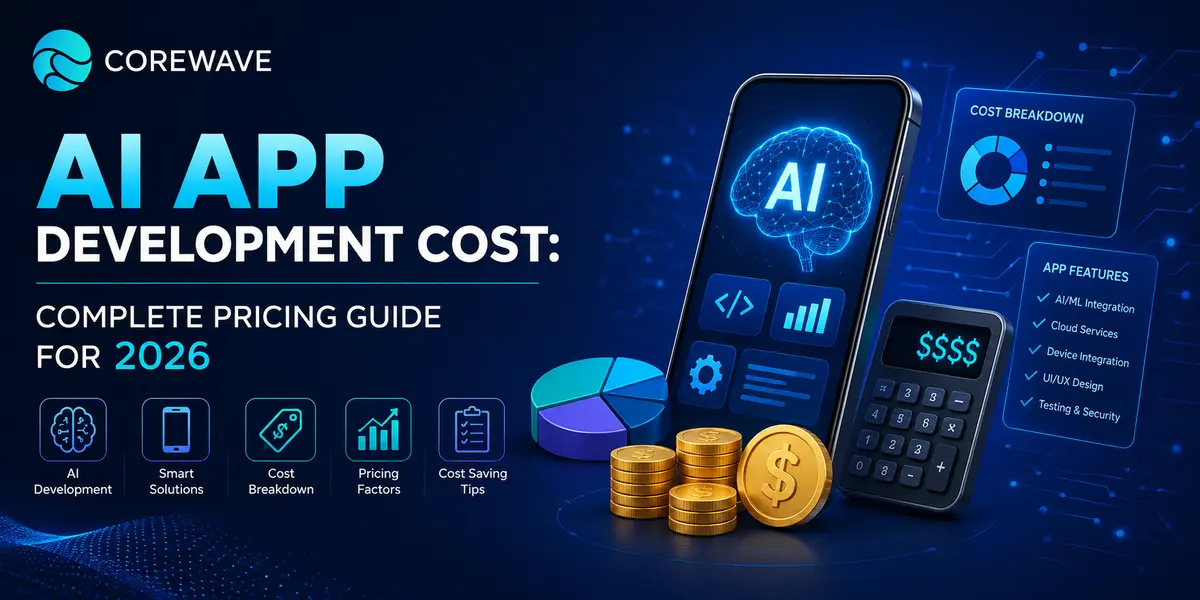

AI App Development Cost in 2026 is expected to cost anywhere from $15,000 to $300,000+. Complexity of the mobile application, the AI features, the development team, the technology stack, and the deployment options will all have a significant impact on the actual total cost. A basic mobile app with some AI features will cost much less than an enterprise grade AI solution with completely tailored machine learning models, advanced analytics, and large-scale integrations.
Artificial Intelligence (AI) is a key technology that is becoming a core component of modern digital products. From chatbots and assistants to AI in healthcare and diagnostics, to recommendation engines, fraud detection and prevention, risk and anomaly analysis, predictive analytics and forecasting, IA, EA and knowledge graph technology, AI/ML powered recommender systems, personalization engines, voice interfaces, text to speech conversion, and more AI technologies are being rapidly adopted. Every industry is investing in intelligent applications to improve customer experience and operational efficiency.
As AI adoption grows around the world, one of the most common questions business owners, startup founders and enterprise decision-makers ask is, "How much does AI app development cost?” The answer is not simple because every AI project is unique. Factors such as complexities of mobile applications, selected AI models, cloud environments, third-party APIs, compatibility and integration, sustainment, and more will impact the final budget.
If you are considering the development of an AI-powered mobile app or web application, understanding the AI App Development Cost before embarking on the project is prudent. Knowing the costs beforehand allows you to set the budget and expect costs. You avoid losses which might be incurred through the unexpected outflow of funds. Whether you are creating an AI chatbot, healthcare application, fintech solution, eCommerce platform, educations app, or enterprise automation software, understanding the dollar figures in the budget is essential for the longevity of the enterprise.
Our Ultimate AI App Development Cost Guide is a must-read that will help businesses understand the key elements that drive development costs. Using this guide to estimate development costs, not only will your time and cost to estimate the development costs be significantly reduced, but this guide will help you gain a better understanding of the pricing rationale for development, the costs driven by different industries and countries, the hidden costs to be aware of, and the recommended strategies to assist in minimizing the overall investment, while still ensuring quality.
Our guide delivers information needed to help explain the reasoning behind the pricing for development and the costs driven by different industries and countries. Our guide also helps in understanding the costs to be aware of and in offering the recommended strategies to assist in minimizing the overall investment, while still ensuring quality.
Our guide is FAQ friendly. The time and money businesses save, not having to hire consultants, to help them estimate development costs, will be offsetting costs for businesses. Our guide will also help businesses gain a better understanding of the pricing rationale for development and the costs driven by different industries and countries.
AI app development involves creating, building, and releasing apps that leverage Artificial Intelligence (AI). AI apps use Computer Vision, Natural Language Processing (NLP), Predictive Analytics, Generative AI, and other technologies to complete numerous tasks that require intelligence and are performed by humans.
Unlike traditional software that is built around a set of defined rules, AI-based software applications learn from data sets and then make intelligent decisions in real world scenarios. Whether its a chatbot that provides customer service by answering frequently asked questions, an app that predicts illnesses and diagnoses patients, or an eCommerce app that suggests relevant products to individuals, AI technologies help applications be more intelligent, quick, and personalized.
As more and more companies begin to implement AI to build better customer experiences and improve operational efficiencies, determining the AI App Development Cost becomes increasingly necessary. Developing AI applications is project-specific and will vary depending on a number of factors ranging from the type of AI being utilized, how complex the project is, the amount and types of integrations that will be necessary to complete the project, the resources required to complete the project, the features that will be included in the project, the project infrastructure, and finally, the understanding of the AI solutions and how they will be incorporated into the project.
AI applications follow a structure to a T when they process data and deliver intelligent responses. While the AI technology behind applications may seem complex, the overall process can be broken down into a few key steps.
1. Data Collection
Every AI application begins with data. This data may come from users, sensors, databases, images, videos, documents, or business systems. High-quality data helps AI models produce more accurate results.
2. Data Processing
Prior to using the data it collects, developers undertake the cleaning, arranging, and preparation of data. Deleting incorrect and duplicate data helps the AI systems to become more effective in making predictions.
3. Selection of AI Models
A subsequent step involves the selection of the proper AI systems considering the requirements of the application. Developers have at their disposal a wide variety of AI models encompassing Machine Learning, Natural Language Processing, Computer Vision, and Generative AI.
4. Model Training or AI Integration
Businesses have the option of training a custom AI model using their innards datasets, or they can opt to integrate existing AI models. OpenAI GPT, Google Gemini, or Claude are some existing AI models. Using existing AI models can reduce AI model development time, whereas the flexibility and precision of a custom model would be prized.
5. User Interaction
Once a user has performed an action, such as asking a question, uploading an image, or requesting a recommendation, the application sends the request to the AI model. The AI system engages the input and dynamically generates an intelligent answer in real time.
6. Continuous Learning
Numerous types of AI systems improve continuously over time in their efforts to develop responses to interactions posed by users. This helps businesses in providing better recommendations and in becoming more effective in their responses to automation predictions.
| Stage | Purpose |
|---|---|
| Data Collection | Gather relevant business and user data |
| Data Preparation | Clean and organize datasets |
| AI Model Selection | Choose the appropriate AI technology |
| AI Integration | Connect or train AI models |
| Application Development | Build the mobile or web application |
| Testing & Deployment | Launch and optimize the AI solution |
| Continuous Improvement | Update and enhance AI performance |
This workflow explains why the AI App Development Cost can vary significantly. Applications with custom AI models, large datasets, and advanced automation typically require a higher investment than apps using pre-trained AI services.
Artificial Intelligence has the potential to considerably impact almost every industry. AI can assist in developing fast, effective applications. The choice of AI application directly correlates to development time, complexity, required devices, costs, and risks associated with developing AI applications.
Here are some of the most common AI applications:
AI chatbots automate customer support by answering questions and providing assistance 24/7. They are widely used in almost every industry from eCommerce to banking, healthcare, travel, and customer service.
Recommendation engines suggest products, videos, music or services based on user behavior. Platforms such as Netflix, Amazon, and Spotify rely heavily on AI-powered recommendation systems.
Healthcare apps use AI to assist with disease prediction, medical imaging, patient monitoring, appointment scheduling, and virtual consultations. These applications improve patient care while reducing administrative workload.
Retail businesses use AI to personalize shopping experiences, recommend products, forecast demand, optimize pricing, and improve inventory management.
Financial institutions implement AI for fraud detection, credit scoring, investment analysis, expense tracking, and automated financial assistance.
Educational platforms use AI to create personalized learning experiences, automated assessments, language translation, and virtual tutoring systems.
AI helps real estate businesses recommend properties, estimate property values, predict market trends, and automate customer interactions.
AI improves logistics by optimizing delivery routes, forecasting inventory demand, managing warehouses, and reducing transportation costs.
In manufacturing, artificial intelligence is used for predictive maintenance, quality inspections, production schedules, and machine monitoring. All are aimed at improving operational efficiency.
The further AI adoption moves into mainstream business practices, the greater will be the proliferation of intelligent applications across various industries. The aim will be to improve operational efficiencies, customer satisfaction, and profitability. The proposed solutions will complicate the development of AI applications and, therefore, the costs associated with the development of the AI applications. It will, therefore, be necessary to define the project requirements prior to the development of the AI applications.
The AI App Development Cost can be estimated to be anywhere from $15,000 to over $300,000, depending on the apps complexity and AI and other advance features needed for the app. The app may require different technologies and integrations, different cloud platforms, different security levels, and different development teams in different locations. The costs would vary depending on all the factors and requirements necessary for the app.
As AI adoption becomes more available to small and medium enterprises, intelligent applications will become common to improve operational efficiencies, customer satisfaction, and profitability. The existing solutions will be much more sophisticated than previously and will therefore complicate the development of AI applications, resulting in much higher AI App Development Costs. It will therefore be necessary to define the project requirements prior to the development of the AI applications.
The AI App Development Cost Guide below gives pricing estimates to help businesses understand how much they should allocate for developing different types of AI-powered apps in 2026.
Basic AI apps are ideal for initial AI implementations. In the initial stages like startup or early growth phases for small businesses, these apps can be beneficial.
Common Features
These applications typically rely on existing AI APIs instead of training custom machine learning models, making them faster and more affordable to develop.
Estimated Cost
$15,000 – $40,000
Estimated Timeline
2 – 4 Months
Best For
Medium-complexity AI applications provide more advanced features and integrations, and are generally built for growing businesses which require intelligent automation, personalized experiences, and advanced data analysis.
These projects typically integrate multiple AI services, support larger user groups, and more sophisticated workflows.
Common Features
Development teams are able to customize pre-trained AI models, as well as fine-tune them with custom business datasets, as a means to increase accuracy.
Estimated Cost
$40,000 – $120,000
Estimated Timeline
4–8 Months
Best For
Enterprise AI applications provide intelligent software capabilities for large scale businesses which require secure, scalable solutions for automation, analysis, and interpretation of substantial amounts of data in real time.
These projects normally involve custom AI model development and advanced cloud solutions, alongside multiple third-party integrations, enterprise-grade security, and ongoing optimization of AI models.
Common Features
Enterprise applications require larger development teams, AI engineers, cloud architects, DevOps specialists, and cybersecurity experts, which significantly increases the overall AI App Development Cost
Estimated Cost
$120,000 – $300,000+
Estimated Timeline
8–18 Months
Best For
| App Type | Estimated Cost | Development Time | Typical AI Features | Best For |
|---|---|---|---|---|
| Basic AI App | $15,000 – $40,000 | 2–4 Months | AI chatbot, recommendations, automation | MVPs, Startups, Small Businesses |
| Medium Complexity AI App | $40,000 – $120,000 | 4–8 Months | NLP, image recognition, voice AI, analytics | SMBs, Healthcare, Retail, FinTech |
| Enterprise AI Solution | $120,000 – $300,000+ | 8–18 Months | Custom AI, ML models, predictive analytics, LLMs | Large Enterprises & Global Organizations |
| Complexity Level | Average Budget | Suitable Business Size |
|---|---|---|
| Basic | $15K–$40K | Startup |
| Moderate | $40K–$120K | Small & Medium Business |
| Advanced | $120K–$300K+ | Enterprise |
Even two applications with similar user interfaces can have significantly different budgets because the complexity of the AI system behind the scenes varies greatly.
The complexity of the AI system behind the scenes is the primary driver of the budget for AI App Development. Other cost drivers associated with AI App Development include the level of customization of AI models, advanced AI features, choice of integration platforms and development frameworks, required levels of security and compliance, cloud computing and AI resources, and required levels of support, monitoring, and adaptation. The more complex and scalable your AI application is, the higher the development cost will be.
The biggest factors that influence AI App Development Cost include project complexity, AI features, model selection, development platform, technology stack, team expertise, third-party integrations, cloud infrastructure, and security requirements. The more advanced and scalable your AI application is, the higher the development cost will be.
No two AI applications command the same price, because each business aims to accomplish different targets and employ different users and different technical requirements. For instance, constructing an AI chatbot for customer support takes less time and money than building a deep learning healthcare platform that analyses medical images.
Before seeking a development cost estimate, it’s important to get an idea of the direct factors that influence the total project cost the most.
Project complexity is amongst the most determining factors impacting the AI App Development Cost.
An AI application with limited functionality takes less development time than a solution for multiple enterprise use cases with multiple AI modules, real-time analytics, and custom workflows.
Generally, AI projects fall into three categories:
| Complexity | Example | Estimated Cost Impact |
|---|---|---|
| Basic | AI chatbot, FAQ assistant | Low |
| Medium | AI recommendation system, education app | Medium |
| Advanced | Healthcare AI, FinTech AI, enterprise automation | High |
As project complexity increases, development time, testing efforts, infrastructure requirements, and maintenance costs also grow.
Features
The number and complexity of features have a direct impact on development time and budget.
Basic applications may only require login functionality and an AI chatbot, while enterprise applications often include advanced automation, dashboards, analytics, and integrations.
Some popular AI features include:
Every additional feature requires extra design, development, testing, and optimization.
Choosing the right AI model significantly influences development cost and application performance.
Different AI technologies serve different purposes.
| AI Technology | Common Use Cases |
|---|---|
| Machine Learning | Predictions, recommendations |
| Natural Language Processing (NLP) | AI chatbots, language understanding |
| Computer Vision | Face detection, image analysis |
| Generative AI | Content generation, virtual assistants |
| Predictive Analytics | Business forecasting |
| Deep Learning | Complex pattern recognition |
Selecting an advanced AI model often increases development effort but also delivers better automation and more intelligent user experiences.
One of the first major budget decisions is whether to opt for a custom AI model or a model that’s ready to use.
Custom AI models are trained with datasets that are related to the company’s needs.
Benefits
Challenges
Many companies opt for ready-to-use AI services to cut costs and reduce development time.
Popular AI service providers include:
Benefits
Challenges
For startups and MVPs, ready-to-use AI models are the cost-efficient option, while enterprises may benefit from custom AI solutions.
Devising your AI application across several platforms lengthens development time and increases costs.
Businesses may choose:
Implementing different native applications for Android and iOS usually costs more than cross-platform technologies like Flutter or React Native.
If your target audience uses multiple devices, investing in a scalable multi-platform solution may provide better long-term value despite the higher initial budget.
Devising your AI application using specific technologies differentiates how your AI application is built and supported.
The technology stack determines:
How your AI
The development of modern AI projects contains:
Frontend
Backend
AI Frameworks
Database
Using scalable technology options for your development usually results in increased initial costs, but potential reduced maintenance costs and greater support for future growth.
The experience and size of your development team plays a major role in determining project costs.
A typical AI development team may include:
| Team Member | Primary Responsibility |
|---|---|
| Project Manager | Planning and coordination |
| UI/UX Designer | User interface and experience |
| Frontend Developer | Client-side development |
| Backend Developer | Server-side logic |
| AI/ML Engineer | AI model integration and optimization |
| QA Engineer | Testing and quality assurance |
| DevOps Engineer | Deployment and cloud management |
Hiring experienced AI specialists generally costs more, but it also improves code quality, reduces technical risks, and accelerates project delivery.
Many AI applications rely on external APIs instead of building every feature from scratch.
Common API integrations include:
While APIs speed up development, they often introduce recurring subscription or usage-based costs that should be included in the overall project budget.
AI applications require reliable cloud infrastructure to process data, store information, and deliver intelligent services.
Popular cloud platforms include:
Cloud costs depend on:
Applications processing large amounts of data or running advanced AI models generally require more powerful—and more expensive—cloud infrastructure.
Security is essential for any AI application, especially in industries that handle sensitive information.
Businesses have some needs for:
Depending on the industry, compliance with standards and regulations is also a necessity, to include:
It helps reduce legal and business risks while increasing user confidence and trust.
The Final AI App Development Cost comes from a combination of technical, business, and operational factors rather than a single pricing formula which is expected. Clear project scope definition, the right AI technologies selection, and the essential feature prioritization would help the costs be in control while the applications scalability, security, and readiness for future growth are assured.
AI Application Development Costs Can Differ Substantially by Industry Because Each Sector Has Unique Business Needs, Compliance Requirements, AI Functionality and Integration Capabilities, and More. For Example, A Retail AI Program that Offers Product Suggestions is Much Cheaper Than A Healthcare AI Solution that Provides Medical Imaging with Predictive Diagnostics and HIPAA Compliant Data Security.
Understanding the Right AI Solution Begins With Knowing Your Industrys Challenges and the Features Required to Solve Them. While Some Companies Only Require AI Powered Automation, Others Require Complex Machine Learning Models, Real-Time Analytics, Computer Vision, or Predictive Intelligence.
Below Is an Industry Wise breakdown to Help Estimate the AI App Development Cost for Different Business Sectors.
Healthcare Is One of the Fastest Growing Industries that Is Adopting Artificial Intelligence. AI Helps Hospitals, Clinics, Telemedicine Providers, and HealthTech Startups Improve Patient Care, Automate Operations, and Support Medical Professionals with Data-Driven Insights.
Popular AI Features Include:
Healthcare Applications Also Require Strict Security, Regulatory Compliance, and High Data accuracy, Making Them One of the Most Complex AI Solutions.
Estimated AI App Development Cost
$70,000 - $300,000+
AI is transforming the real estate industry by helping buyers, sellers, and agents make smarter decisions through automation and predictive analytics.
Common AI capabilities are things like:
Real estate applications of AI are often lower in compliance by comparison to AI applications in other fields.
Estimated AI Application Development Cost
Between $40,000 and $150,000
Banking, FinTech, Insurance, and Investment Services, to name a few, are increasingly cornered into AI-based solutions to enhance security, fully automate financial services, and limit fraud.
Some of the more popular AI capabilities include:
Financial applications demand enterprise-grade security, compliance, and real-time processing. As such, they constitute some of the most technically demanding of all AI applications.
Estimated AI App Development Cost
Between $80,000 and $350,000+
Applications of AI in Educational Establishments and their related spin-offs (EdTech) are intended to provide personalized learning pathways and heighten levels of engagement of students.
Some of the more popular AI functionalities include:
AI EDUCATION applications demand moderate levels of AI complexity balanced and focused on user scalability and engagement.
Estimated AI Application Development Cost
Between $35,000 and $120,000
Applications of AI in the areas of Retail and eCommerce are intended to maximize business sales and improve the quality of services offered to the public and minimize levels of fraud.
Some of the more popular AI functionalities
AI App Development Costs
$40,000 - $180,000
AI use in logistics and supply chain companies is intended to aid automation of movement, storage, and distribution operations.
Common AI features are:
Operations often process extensive volumes of operational data in real time. This increases service infrastructure along with higher demands on cloud computing.
AI App Development Costs
$60,000 - $220,000
Manufacturing companies investing in AI are interested in improving production, reducing production time, and improving quality processes.
The most in-demand AI capabilities are:
Manufacturing AI solutions frequently integrate with IoT devices and enterprise resource planning (ERP) systems, increasing overall project complexity.
Estimated AI App Development Cost
$70,000 – $250,000
AI can optimize the travel industry by allowing companies to create personalized experiences, enhance customer needs through real-time support, and streamline the travel process by decreasing the time it takes to complete a booking.
Some popular AI features that travel companies can implement to boost their customer experience:
Travel applications typically integrate with multiple third-party APIs, including airlines, hotels, maps, and payment gateways.
Estimated AI App Development Cost
$45,000 – $170,000
| Industry | Typical AI Features | Estimated Development Cost | Development Complexity |
|---|---|---|---|
| Healthcare | Medical AI, telemedicine, predictive analytics, EHR integration | $70,000 – $300,000+ | Very High |
| Real Estate | Property recommendations, AI valuation, virtual assistant | $40,000 – $150,000 | Medium |
| Finance | Fraud detection, credit scoring, investment analytics | $80,000 – $350,000+ | Very High |
| Education | AI tutor, personalized learning, analytics | $35,000 – $120,000 | Medium |
| Retail | Product recommendations, AI shopping assistant, demand forecasting | $40,000 – $180,000 | Medium to High |
| Logistics | Route optimization, fleet management, predictive analytics | $60,000 – $220,000 | High |
| Manufacturing | Predictive maintenance, Computer Vision, automation | $70,000 – $250,000 | High |
| Travel | AI travel assistant, itinerary planning, chatbot | $45,000 – $170,000 | Medium to High |
Industries such as Healthcare and Finance generally have the highest AI App Development Cost due to strict compliance requirements, advanced AI capabilities, large datasets, enterprise-level security, and mission-critical performance expectations.
On the other hand, industries like Education, Retail, and Real Estate can often launch AI-powered solutions with a lower initial investment by leveraging pre-trained AI models and cloud-based AI services.
There is no universal budget for building an AI application. The AI App Development Cost depends heavily on the industrys requirements, AI functionality, compliance standards, scalability, and integration needs. Defining your business objectives and selecting only the AI features that provide measurable value will help you control costs while building a solution that supports long-term growth.
The AI development cost for your app depends on the features you incorporate within your app. Basic AI capabilities like chatbots, or OCR generally require a lower cost of investment however advanced features such as Generative AI, Computer Vision Predictive Analytics and multi-lingual AI assistants increase complexity of development and overall cost.
When preparing the development of an AI application, its essential to prioritize features according to your business goals instead of seeking to cover everything in the initial release. Many successful companies start by releasing a Minimum Viable Produ (MVP) and gradually expand to include advanced AI features as their client base expands.
Below are the top well-known AI features that are utilized in modern applications, along with their estimated development costs.
AI chatbots are among the most widely-used AI tools across industries. They assist businesses in automating customer support, respond to frequently asked questions, create leads and offer instant assistance 24 hours a day.
Modern AI chatbots are able to understand natural language, manage conversations, and connect to CRM systems websites, mobile applications as well as messaging platforms.
Common Use Cases
Estimated Development Cost
$8,000 - $40,000
Voice assistants let users interact with applications by using voice commands, instead of typing. They enhance accessibility, hands-free operation and user engagement.
Voice AI is used extensively in healthcare and smart homes automotive applications education, as well as customer service.
Common Features
Estimated Development Cost
$15,000 - $60,000
Image recognition makes use of Computer Vision to identify faces, objects documents, products, or images for medical purposes.
This technology is extensively employed in retail, healthcare diagnostics manufacturing, security and logistics.
Popular Applications
Estimated Development Cost
$20,000 - $80,000
Recommendation engines study the behavior of users to provide customized suggestions that boost user engagement as well as conversions.
These systems are typically employed by streaming services, eCommerce platforms education apps, and real estate portals.
Typical Recommendations
Estimated Development Cost
$15,000 - $70,000
Predictive Analytics aids businesses in forecasting future outcomes based on real-time and historical data.
Organizations employ models that predict the future to take better decisions, reduce risk and improve efficiency of operations.
Common Use Cases
Estimated Development Cost
$25,000 - $100,000
OCR technology converts handwritten or printed text from images and documents into editable digital content.
It greatly reduces the need for manual data entry and improves the efficiency of document processing.
Common Applications
Estimated Development Cost
$10,000 - $50,000
Generative AI is among the technologies that will be growing at the fastest rate in 2026. It allows applications to create text images, codes and reports, summaries of emails and other kinds of content based upon user-generated requests.
Many companies use OpenAI GPT, Google Gemini, Claude or other similar large Language Models (LLMs) to provide intelligent assistants and features for creating content.
Popular Use Cases
Since these systems typically require advanced rapid engineering, API integration, security controls and an scalable cloud infrastructure generally, they have more expensive development costs.
Estimated Development Cost
$25,000 - $120,000+
Multilingual AI lets applications comprehend and communicate in a variety of languages which makes them appropriate for global audience.
This feature is especially useful for international companies as well as travel platforms, healthcare suppliers, as well as customer service applications.
Common Capabilities
Estimated Development Cost
$10,000 - $45,000
| AI Feature | Common Business Use | Estimated Development Cost | Complexity |
|---|---|---|---|
| AI Chatbot | Customer support, lead generation | $8,000 – $40,000 | Low–Medium |
| Voice Assistant | Voice commands, accessibility | $15,000 – $60,000 | Medium |
| Image Recognition | Healthcare, security, retail | $20,000 – $80,000 | High |
| Recommendation Engine | eCommerce, OTT, real estate | $15,000 – $70,000 | Medium–High |
| Predictive Analytics | Forecasting, finance, healthcare | $25,000 – $100,000 | High |
| OCR | Document automation, banking | $10,000 – $50,000 | Medium |
| Generative AI | Content creation, AI assistants, automation | $25,000 – $120,000+ | Very High |
| Multilingual Support | Global applications, customer support | $10,000 – $45,000 | Medium |
There is no guarantee that all AI feature is needed to every single application. Businesses should pick features that address real-world problems for users and help enable long-term growth.
For an example:
Each AI feature is valuable however, it also adds the development time testing requirements, development time, and costs for infrastructure. Selecting the best mix of features according to your companys goals is among the most efficient methods to reduce the AI app development cost while providing a high-performance, scalable application that is able to meet the expectations of users.
The AI Application Development Cost differs significantly from country due to the differences in the salaries of developers as well as labor costs, technical knowledge business regulations, infrastructure and the market demand. Countries like those in the USA, UK, Canada, Germany, and Australia generally have higher development costs and India provides an affordable alternative that has access to skilled AI engineers and internationally competitive development services.
Selecting the best development location is more than hourly rates. Businesses must also look at the technical capabilities, communication skills and time zone compatibility, industry knowledge security standards, as well as long-term support prior to selecting the best AI development partner.
Below is a breakdown by country of the estimated AI development costs for AI applications through 2026.
The United States is one of the most important markets in the world for Artificial Intelligence innovation. A large number of the biggest AI companies as well as startups and technology companies operate in the United States which makes it an ideal option for highly complex AI projects.
AI team members in the USA usually specialize in healthcare, enterprise applications and fintech, autonomous systems and Generative AI solutions.
Advantages
Considerations
Average Hourly Rate
$120-$250/hour
Estimated AI App Development Cost
$80,000-$400,000+
Canada has grown into a global center in Artificial Intelligence research and software development. Cities like Toronto, Montreal, and Vancouver are renowned for their thriving AI technology and talent.
Canadian development companies typically provide high-end enterprise AI solutions, but with lower costs than the majority of US-based companies.
Advantages
Average Hourly Rate
$90-$180/hour
Estimated AI App Development Cost
$60,000-$250,000
The United Kingdom is a major hub in AI development in Europe especially in healthcare, finance and the development of enterprise software.
Businesses select UK development teams to get top-quality engineering and regulatory expertise, as well as cutting-edge AI consulting.
Advantages
Average Hourly Rate
$100-$200/hour
Estimated AI App Development Cost
$70,000-$300,000
Australia has seen an explosion in AI adoption in mining, healthcare logistics, retail and financial services.
Australian software companies concentrate on the development of scalable AI applications that are designed for use in enterprise environments and cloud-native architectures.
Advantages
Average Hourly Rate
$90-$180/hour
Estimated AI App Development Cost
$60,000-$250,000
Germany is known for its work in developing AI-powered manufacturing automation, industrial automation automotive software, and enterprise systems.
German AI companies place a high value on accuracy, security and compliance, as well as long-term reliability of software.
Advantages
Average Hourly Rate
$100-$220/hour
Estimated AI App Development Cost
$80,000-$320,000
The United Arab Emirates has become one of the fastest-growing AI markets in the Middle East. Businesses in Dubai as well as Abu Dhabi are investing heavily in AI-driven digital transformation smart cities, smart cities, logistics, healthcare, and government services.
Many UAE companies work with international development partners while ensuring local project management and business advisory.
Advantages
Average Hourly Rate
$60-$150/hour
Estimated AI App Development Cost
$50,000-$220,000
India is now one of the most sought-after places to go to develop AI software development because of its vast number of skilled developers with competitive pricing and a wealth of experience in delivering worldwide software development projects.
Many small and medium-sized businesses, startups and Fortune 500 companies choose Indian development teams for AI application development because they offer top-quality services at considerably cheaper prices compared to North America and Europe.
Advantages
Average Hourly Rate
$25-$70/hour
Estimated AI App Development Cost
$15,000-$120,000
| Country | Average Hourly Rate | Estimated AI App Development Cost | Best For |
|---|---|---|---|
| USA | $120–$250/hr | $80,000–$400,000+ | Enterprise AI, Healthcare, FinTech |
| Canada | $90–$180/hr | $60,000–$250,000 | Enterprise Apps, SaaS, AI Startups |
| UK | $100–$200/hr | $70,000–$300,000 | Finance, Healthcare, Enterprise Solutions |
| Australia | $90–$180/hr | $60,000–$250,000 | Logistics, Retail, Enterprise Applications |
| Germany | $100–$220/hr | $80,000–$320,000 | Manufacturing, Automotive, Industrial AI |
| UAE | $60–$150/hr | $50,000–$220,000 | Smart Cities, Government, Healthcare |
| India | $25–$70/hr | $15,000–$120,000 | Startups, SMBs, Global AI Development |
The best option is based on your budget, the complexity of your project and your business goals.
Location is a key factor when determining AI App development Cost but the lowest hourly cost does not always yield the greatest long-term value. Businesses should consider the technical knowledge as well as communication, security as well as scalability and post-launch support in order to choose a partner for development that is compatible with their financial goals and the long-term vision.
The most well-known AI technologies of 2026 are OpenAI GPT, Google Gemini, Anthropic Claude, TensorFlow, PyTorch, LangChain, Vector Databases, Retrieval-Augmented Generation (RAG) and Llama Models. These technologies provide everything from AI chatbots and virtual assistants to enterprise automation smart search, predictive analytics and artificial intelligence (AI) that is generative. AI applications.
Selecting the best AI technology stack is among the most crucial decisions made in the course of any AI project. The AI technologies you choose directly impact your applications performance as well as its scalability, development schedule and the overall AI development cost. Although some applications are made to build machine learning models, others are focused on connecting Large Language Models (LLMs) or managing vector data or enhancing AI response accuracy.
Below are the top AI technologies that companies are using in 2026.
OpenAI
OpenAIs GPT models are one of the most popular Large Language Models (LLMs) for AI-powered applications. Companies use OpenAI to develop smart chatbots, virtual assistants tools for creating content as well as coding assistants and automated solutions for enterprises.
Common Use Cases
Advantages
Ideal for: Generative AI applications and conversational AI.
Google Gemini is a multimodal AI model that can comprehend audio, text, images video, and code. It is seamlessly integrated with Googles ecosystem and provides advanced reasoning across a variety of data formats.
Common Use Cases
Advantages
is ideal for: Businesses building AI applications within the Google Cloud ecosystem.
Claude, which was developed by Anthropic, was developed with a focus on security reliability, reliability, as well as long-context reasoning. It is extensively used for document analysis as well as AI assistants.
Common Use Cases
Advantages
Best suited for: Organizations handling large amounts of unstructured and structured content.
TensorFlow is among the most popular open-source machine learning frameworks. It lets developers build models, train, and deploy AI models across mobile, cloud as well as edge.
Common Applications
Advantages
Best for: Custom AI model development and machine learning for enterprises.
PyTorch is now the most popular framework used for AI research as well as advanced deep-learning projects due to its ability to be flexible and easy to experiment with.
Common Applications
Advantages
Best suited for: Research-intensive AI projects and advanced model development.
LangChain is an application framework that makes it easier to build applications that are powered by Large Language Models. It allows developers to connect LLMs with APIs, tools databases, databases, and business workflows.
Common Use Cases
Advantages
Best suited for: Building intelligent AI assistants and AI agent applications.
Vector databases can store and retrieve high-dimensional embeddings which allows semantic search in lieu of the traditional keyword-based search.
Popular vector databases include:
Common Use Cases
Advantages
Ideal for: AI-powered search engines and enterprise knowledge systems.
RAG RAG combines Large Language Models with external sources of knowledge that allow AI systems to find relevant information prior to creating responses.
Instead of relying solely on a pre-trained set of knowledge, RAG enables AI applications to access corporate documents websites, databases and internal knowledge bases in real-time.
Common Applications
Advantages
Best suited for: Enterprise AI applications needing up-to-date data.
Llama is part of Metas family of lightweight, open Large Language Models, widely employed by companies looking to gain better control over AI deployment and customizing.
Organizations can tweak Llama models with proprietary data sets and then deploy models in private networks.
Common Use Cases
Advantages
Ideal for: Organizations that require private, customized AI deployments.
The best technology is determined by your companys goals and requirements for application, as well as your budget.
The AI ecosystem of 2026 provides an array of powerful technologies to build intelligent applications. The right mix of LLMs, machine-learning instruments, orchestration frameworks and retrieval tools will improve the performance of your application in development, speed up development, and reduce the total AI development cost. Businesses should assess each technology on the basis of the ability to scale, security, and customization requirements and long-term maintenance needs to create AI solutions that are competitive in the ever-changing technology landscape. changes.
Choosing the best AI application development company requires evaluating their technical expertise, experience in the industry, AI technology stack, portfolio of development processes security practices as well as communication, pricing transparency and post-launch assistance. The ideal partner should not just build your app but also assist you in creating an efficient and flexible AI solution that is in line with your long-term goals for business.
The effectiveness of an AI project is dependent in the same way on the mobile app developer as it depends with the technology itself. A seasoned AI development firm can assist you in choosing the appropriate architecture, reduce risks of development, maximize the AI app development cost and produce the highest-quality product in time.
Before you make a decision take into consideration the following aspects.
Not all software companies specialize in Artificial Intelligence. Find a team that has years of experience in creating, developing and deploying AI-powered software.
A reputable AI development firm should have experience in:
Ask if the company collaborated on similar projects to yours, and what AI technologies they would recommend for your particular application.
A strong portfolio of projects demonstrates real-world experience and the ability provide actual-world AI solutions.
When you review previous projects, be sure to look for:
Case studies that describe the business problem, AI solution, and tangible results offer valuable insights into the capabilities of the business.
Every industry has its own requirements as well as workflows and the requirements for compliance.
For an example:
A company with a relevant track record in the industry can cut development time and avoid typical implementation problems.
A well-organized development process provides transparency, predictable timelines and a better process for managing projects.
A reputable AI development company must adhere to a process that includes:
Ask them how they handle communication milestones, reports on progress throughout the duration of the project.
The stack of technology directly influences application performance, scalability and maintenance in the future.
Find out which technologies your company employs to:
A modern technology stack can ensure that your application is adaptable and scalable as your business expands.
Security must be incorporated into the design from the very beginning, and not added later on during development.
Verify that the business follows safe development practices, such as:
If your business operates in regulated industries, verify their compliance by comparing their experience to standards like GDPR, HIPAA, or PCI DSS.
Achieving success with AI projects require consistent communication as well as clear expectations.
Ask questions like:
Transparent communication helps reduce confusion and helps keep the project on track.
The cheapest price isnt always the most value.
Instead of focusing solely on cost, consider:
Request a comprehensive proposal that outlines precisely whats included and whether any recurring costs are applicable.
The launch of an AI application is just the beginning.
Choose a partner for development that provides:
Long-term maintenance will ensure that your application will continue to function well as user requirements and AI technology develop.
Before signing a contract think about asking:
These questions will help you evaluate the technical expertise, transparency, and the long-term stability of the company.
Be cautious if a business:
Be aware of these warning signs in advance can save you from cost-intensive project delays and issues with quality.
Selecting the best AI firm for app development is among the most crucial decisions on the course of your AI journey. A reliable partner will bring the expertise of a professional, industry-specific expertise, clear communication and long-term support that will ensure your project is successful. Instead of selecting a firm just based on price be sure to consider the past experience, the results that have been proven quality standards for security, development methods and scaling. A good development partner can assist you in optimizing the AI App development Cost and reduce risk and create an AI solution that provides long-lasting business value.
The AI App Development Cost typically is between $15,000 to more than $300,000. by 2026. The final cost will depend on factors like project complexity, AI features, platform selection as well as custom AI models integrations from third-party companies cloud infrastructure security requirements, and the experience of the team developing it.
An entry-level AI application typically takes about 2-4 months and medium-complexity projects need between 4 and 8 months. Enterprise AI solutions that incorporate advanced features and customized AI models can be between 8 and 12 months or even longer depending on the complexity and integrations.
A variety of factors affect the total cost, such as:
AI is changing nearly every industry However, some of the top adopters are:
Every industry uses AI differently to automatize processes, enhance customer experience, and improve the efficiency of operations.
Its all about your businesss goals.
pre-trained AI models are quicker to implement, less expensive and suitable for the majority of small and medium-sized enterprises.
Custom AI models offer higher accuracy and more customization but they take longer as well as larger datasets and more money for development.
Some of the most popular AI technology include:
The appropriate technology depends on the requirements of your application and its the requirements for scalability.
Yes. AI applications are designed to support:
Many companies opt for cross-platform development to cut costs and also launch on different platforms simultaneously.
Beyond the initial budget for development, companies must also think about:
Making plans for these ongoing expenses can help avoid unexpected expenses after the launch.
You can maximize your financial plan by
These strategies can help cut costs without the loss of quality.
Yes. Startups are increasingly using AI to automatize their processes, increase customer satisfaction and develop innovative products.
Many startups start with an MVP and use already-trained AI models to reduce development costs while proving their business ideas.
When choosing an AI partner for development, consider:
A team of experts can help reduce the risks of projects and guarantees an efficient, high-quality solution that is scalable.
Machine Learning (ML) is focused on analysing the data, finding patterns and making predictions based upon historical data.
Generative AI creates new content, such as images, text or audio by using Large Language Models (LLMs) and other generative models.
Both technologies are able to work in modern AI applications.
In the majority of instances it is. Cloud platforms offer the power of computing, storage capacity, and scalability required for processing AI workloads effectively.
However, certain applications make use of On-device AI or Edge AI to process data locally, enhancing speed and privacy while decreasing dependency on cloud services.
14. How much will AI maintenance of the app cost?
Maintenance for the year typically costs 15 to 25 percent of the initial AI app development cost. This includes:
Regular maintenance ensures that the software is secure, scalable, and up-to-date.
AI can help businesses automate routine tasks, boost decision-making, customize customer experiences, cut operational costs, and open up potential revenue streams.
In the midst of AI adoption continues to increase across all industries, investing into AI-powered applications by 2026 will aid businesses in staying ahead of the competition, improve efficiency, and gain the long-term advantages of digital technology.
Artificial Intelligence is no longer an emerging technology, but its an advantage for companies of all sizes. It doesnt matter if youre creating an AI chatbot or a healthcare platform an fintech solution or a recommendation engine or an Generative AI application knowing the AI cost of app development is the initial step towards making a profitable investment.
The guide revealed that the cost of creating an AI application will depend on a number of aspects, including project complexity, AI features, technology stack cloud infrastructure, development platform security requirements, and the skills of your development team. While the cost of a basic AI application could begin with $15,000 but enterprise-grade AI solutions that use customized models and sophisticated integrations may surpass $300,000..
The positive side is that businesses can maximize their investment by beginning by establishing a Minimum Viable Produ (MVP) that is based on AI models that have been trained, implementing Agile development, utilizing cross-platform technology and planning for scalability over the long term. Making well-informed decisions at the beginning of the project can help reduce risk, manage costs, and speed up the time from idea to.
As AI continues to develop using technologies such as AI Agents, Multimodal AI, Generative AI, Edge AI, and Autonomous AI companies who invest today will be better equipped to provide more efficient customer experiences, improve processes, and ensure sustainable growth in business in the years to come.
If youre planning to create an AI-powered app in 2026, working with an experienced team of developers can help you select the best technology, establish an achievable budget, and then turn your concept into a viable high-performing, secure, and reliable product.
No matter if youre a startup, SME or enterprise, the proper development strategy can turn your AI idea into a profitable digital product.
Corewave is a specialist in complete AI app development to help companies design, develop deploy, and scale intelligent applications for various industries, including real estate, healthcare finance, retail logistics, education manufacturing, and many more.
Set up a no-cost meeting with Corewave today to discuss your requirements for your project and receive a custom AI app development cost estimate and find the most efficient AI solution for your company. Our experts are available to assist you in creating an intelligent application that will deliver quantifiable performance and long-term results.